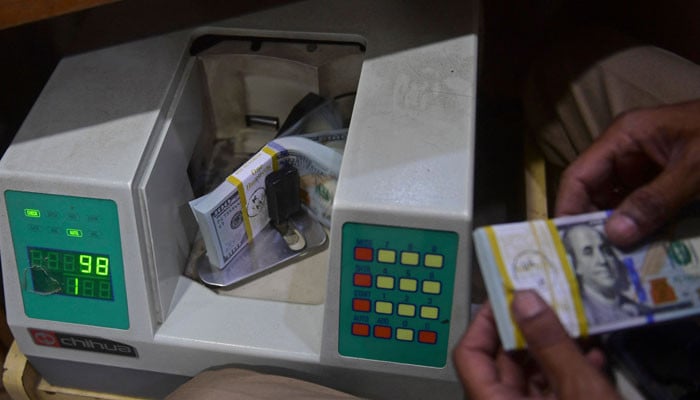
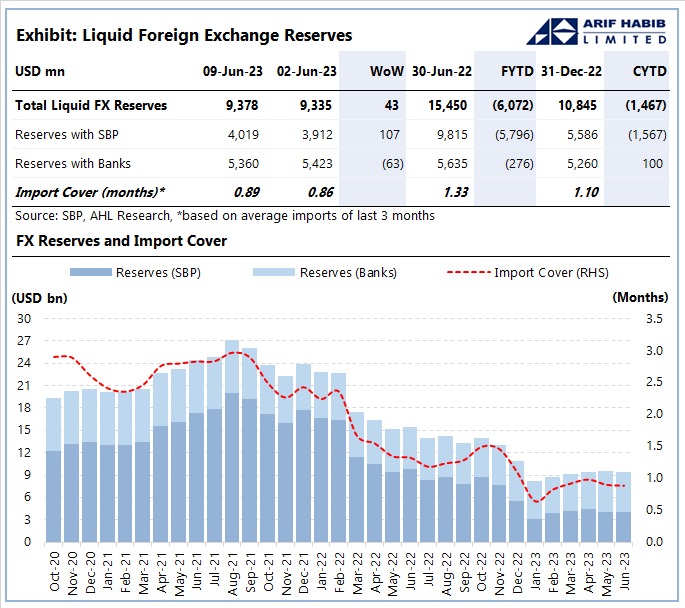
Pakistan’s foreign exchange reserves held by the State Bank of Pakistan (SBP) received a slight boost of over $100 million, providing some relief amidst the country’s ongoing liquidity crunch. The SBP’s statement revealed that the total liquid foreign reserves for Pakistan stood at $9.4 billion at the end of the week on June 9. This increase in Pakistan’s Forex Reserves marks the first positive change in six weeks.
Pakistan’s Forex Reserves Breakdown:
The State Bank of Pakistan’s reserves amounted to $4.018 billion, while commercial banks held $5.4 billion in reserves. The SBP reported an increase of $107 million in its reserves during the week ending on June 9. However, despite this uptick, Pakistan’s import cover remains less than a month, according to Arif Habib Limited.
Challenges in Securing External Financing:
Pakistan currently faces significant challenges in securing external financing, with the expiration of the International Monetary Fund (IMF) program this month. The country’s political instability has had a profound impact on its deteriorating economy, making it difficult to obtain much-needed funding. The $350 billion economy is experiencing financial turmoil and risks default if an agreement with the IMF is not reached soon.
IMF Talks and Chinese Support:
Negotiations between Pakistan and the IMF have been ongoing since January, aiming to resume the $1.1 billion loan tranche that has been on hold since November. This tranche is part of a $6.5 billion Extended Fund Facility (EFF) agreed upon in 2019. Meanwhile, Pakistan has approached China to refinance commercial loans amounting to $1.3 billion. However, without the revival of the IMF program, Pakistan’s foreign exchange reserves held by the State Bank of Pakistan may drop below $3 billion.
Critical Hours Ahead:
In a last-ditch effort, Pakistan and IMF officials are working intensively to revive the stalled Fund-sponsored program under the EFF. The next 48 hours are crucial in achieving a breakthrough. It is expected that Chinese banks may provide refinancing for commercial loans before June 30, and an additional China SAFE deposit of $1 billion will be rolled over during the ongoing financial year.
Bridge Financing Challenges:
One of the major challenges lies in repaying $900 million to multilateral creditors by the end of June 2023, including principal and mark-up repayments. Rollover and refinancing of $2.3 billion from China would still leave Pakistan’s foreign exchange reserves below the $3 billion mark. Moreover, the repayment requirements of $4-6 billion from July to November 2023 pose a significant concern, especially during the political transition following the installation of a caretaker setup.
IMF’s Demands and Budgetary Changes:
The IMF has asked the government to increase the Federal Board of Revenue’s tax collection target to approximately Rs9.8 trillion, surpassing the initial target of Rs9.2 trillion. The IMF also considers the non-tax revenue target of Rs2.9 trillion unrealistic. Pakistan will need to implement substantial changes in its budgetary framework to achieve a broader agreement on the budget for the upcoming financial year.
Sovereignty and Tax Concessions:
In response to the IMF’s objections regarding tax exemptions in the recently unveiled budget, Finance Minister Ishaq Dar emphasized Pakistan’s sovereignty. He stated that Pakistan cannot accept everything the IMF demands and should have the right to provide tax concessions in certain sectors. The government believes that tax concessions are essential to promote economic growth and development.
Published in PakWeb, June 16th, 2023.
Stay informed and engaged with the PakWeb by following us on Facebook, Twitter, and participating in our Discussion Forums.